




It all started when I took an optional subject on World religions in secondary school—I heard it was easy to pass. Upon finishing it, I remember saying to myself, perhaps as a premonition: ‘I’m not religious, but if I had to choose it would be Buddhism’. Fast forward more than 20 years, and I teach meditation & dharma, and have a PhD in Buddhist Studies.
Along the way, I have shifted from an initial fascination with Tibetan Buddhism towards the Pali tradition (the early Buddhist texts and Theravāda), and I gradually put aside my career as a jazz pianist and composer. My approach to meditation has been mainly influenced by the Burmese teacher Sayadaw U Tejaniya, besides my own study of the texts.
I trained as a community dharma leader (CDL) at Gaia House, and later as a dharma and meditation teacher at Bodhi College. From Stephen Batchelor, my primary mentor, I’ve learnt that our dharma needs to keep being updated, and this applies to secular Buddhism itself—otherwise it would ossify into yet another dogma.
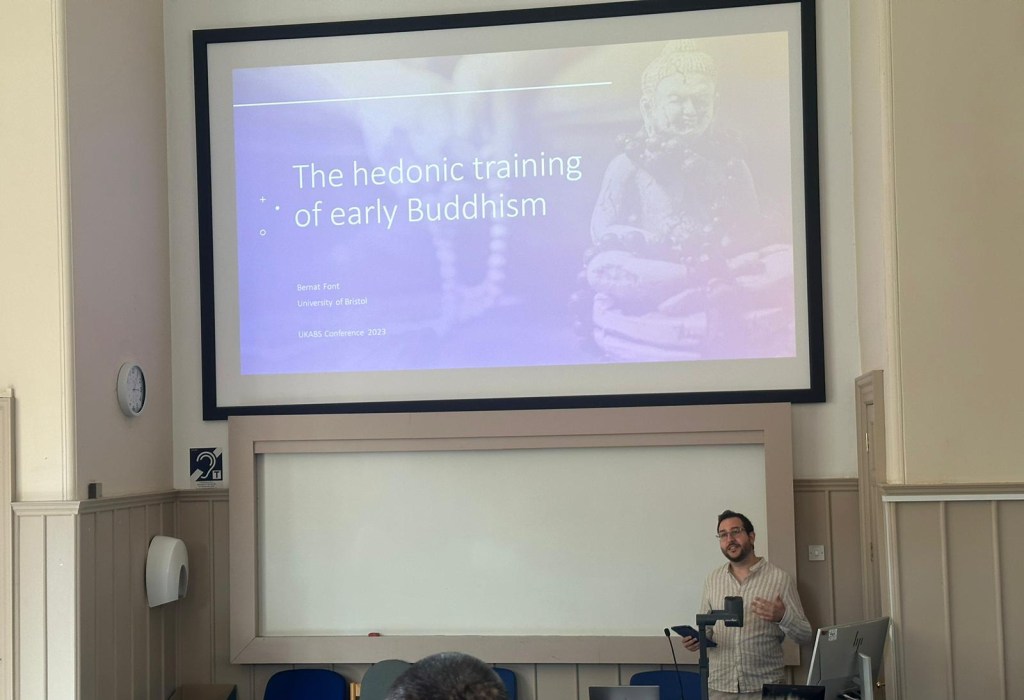
My doctoral thesis explores the notion of vedanā (the pleasant, painful or neutral’ feeling tone’ of experience) in the Pali canon. It focuses on how feeling tone contributes to awakening, especially through positive affect and forms of ‘spiritual pleasure’. I argue that early Buddhism was a form of refined hedonism. Doing research supervised by Rupert Gethin has taught me a lot about approaching the texts and their traditional interpretation, while shattering some biases and colonial attitudes present in forms of Buddhist modernism.
Today I combine spiritual and scholarly approaches. I’m interested in reform, but an informed and respectful one which understands this as a two-way street: be critical of tradition and let tradition criticise you. Instead of defining the secular Buddhist approach with reference to the concept of religion, to ritual forms, or to cultural aspects, I prefer to do so in terms of valuing this vulnerable life rather than aiming for a reality outside of it, reinterpreting the Buddhist doctrine that anything conditioned and impermanent is unsatisfactory.
At the same time, I’m suspicious of over-adapting these teachings to modern consumerist life. We cannot change our lives without changing our lives. To me, the dharma needs to compassionately challenge at least as much as it needs to comfort. Instead of the modern habit of speaking in terms of psychotherapy and neuroscience, I take the dharma to be more akin to communal ethics, practical philosophy and art.
I teach mostly in practical settings—meditation retreats and courses—and I’m convinced this can still be well grounded in the Buddhist texts. ‘Theory’ has a bad rep, but when in service of the practice I believe it is essential, so I teach them together. I particularly engage with the LGBTQ+ and Spanish/Catalan-speaking communities, to which I belong. I also translate ‘suttas’ (discourses) from Pali into Spanish.
 Bernat Font